- Your cart is empty
- Continue Shopping

Best AED for Business: Complete Buying Guide for Offices and Workplaces
Every 90 seconds, someone in the United States experiences sudden cardiac arrest (SCA). While many of these emergencies happen at home, thousands occur in workplace settings where quick access to an automated external defibrillator (AED) can mean the difference between life and death. For every minute that passes without defibrillation, survival rates drop by 7-10%.
If you’re a business owner or office manager researching AEDs for your workplace, you’re making a potentially life-saving decision. But with dozens of models on the market, varying price points, and different feature sets, choosing the right AED can feel overwhelming. This guide walks you through everything you need to know to select the best AED for your business, from essential features to specific product recommendations and ongoing maintenance considerations.
Why Your Business Needs an AED
Sudden cardiac arrest doesn’t discriminate by age or health status. While certain risk factors increase the likelihood, SCA can strike anyone, anytime. In workplace settings, having an AED readily available dramatically increases survival rates. Studies show that when bystanders use an AED within the first three to five minutes of cardiac arrest, survival rates can exceed 70%.
Beyond the moral imperative to protect your employees and visitors, there are practical business reasons to invest in an AED. While federal law doesn’t require most private businesses to have AEDs, some states have specific requirements for certain industries or building types. More importantly, the Cardiac Arrest Survival Act and similar state laws provide liability protection for businesses and individuals who use AEDs in good faith.
Having an AED also demonstrates your commitment to workplace safety, which can positively impact company culture, employee retention, and even recruitment. It shows that you value your team members’ wellbeing and are prepared for emergencies.
Hot
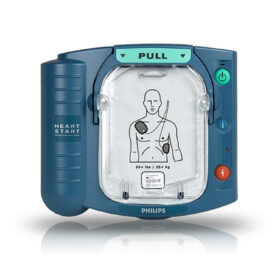
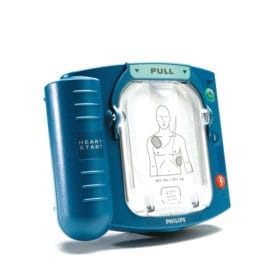
Philips HeartStart OnSite AED M5066A
Rated 5.00 out of 5
(2)
$1,529.00 – $1,749.00Price range: $1,529.00 through $1,749.00
Hot
Hot
Key Features to Consider When Choosing an AED
Not all AEDs are created equal. While every FDA-approved AED will effectively deliver life-saving shocks, several features distinguish models and make them more or less suitable for business environments.
Ease of Use
In a cardiac emergency, every second counts. You need an AED that anyone can operate, even under stress and with zero training. The best AEDs for businesses feature clear voice prompts that guide users through each step, visual displays showing pad placement, and minimal buttons or decision points. Some models include metronome features for CPR pacing, which helps responders maintain proper compression rates.
Look for AEDs with automatic shock delivery (fully automatic) or semi-automatic models that require the user to press a button. For most office environments, semi-automatic devices work well because they give the responder control over when the shock is delivered, though fully automatic models eliminate any hesitation.
Maintenance and Self-Check Capabilities
An AED that sits unused for months or years still needs to function perfectly when called upon. The best business AEDs perform daily, weekly, or monthly self-tests that check the battery, electrodes, circuitry, and software. These self-tests should be indicated by a visible status indicator (usually a green light or checkmark) that allows anyone to verify at a glance that the device is ready.
Consider how often pads and batteries need replacement. Adult AED pads typically last two to five years, while batteries can last two to seven years depending on the model. Longer replacement intervals mean lower long-term costs and fewer maintenance tasks.
Durability and Environment Rating
Office environments might expose your AED to temperature variations (especially if placed near exterior doors or in warehouse areas), dust, or humidity. Check the device’s IP (Ingress Protection) rating, which indicates how well it resists dust and moisture. Most quality AEDs have an IP rating of at least IP55, meaning they’re protected against dust and water jets.
Also consider drop protection. While you hope it never happens, AEDs can accidentally fall during emergency use. Models with robust cases and higher drop ratings (typically 1 to 1.5 meters) provide extra peace of mind.
Cost and Total Cost of Ownership
The purchase price represents just the beginning of your investment. Factor in replacement pads (typically $40-80 per set), battery replacements ($100-300 depending on the model), and accessories like cabinets ($200-500) and signage ($20-50).
AED prices range from about $1,100 for basic models to over $2,600 for premium options with advanced features. For most businesses, models in the $1,400-$2,200 range offer the best balance of features, reliability, and cost-effectiveness. Business packages that bundle the AED with a cabinet, spare pads, signage, and other accessories typically provide better value than buying items separately.
Connectivity and Smart Features
Newer AED models offer connected features that can alert facility managers or medical professionals when the device is used, when maintenance is needed, or if the device fails a self-test. These features typically require either cellular connectivity (which may involve monthly fees) or WiFi.
While connectivity adds convenience, it’s not essential for smaller businesses. However, for organizations with multiple locations or larger facilities with several AEDs, connected monitoring systems can streamline compliance and maintenance tracking.
Best AED Models for Business Settings
Based on reliability, ease of use, cost-effectiveness, and suitability for office environments, here are the top AED options for businesses.
Philips HeartStart OnSite AED
The HeartStart OnSite consistently ranks as one of the best all-around AEDs for business use. It features exceptionally clear voice instructions, an intuitive design that requires minimal training, and proven reliability. The device performs automatic daily self-tests and uses SMART pads that can be used for both adults and children (by following pediatric placement instructions).
Pros: Highly intuitive, excellent voice guidance, reliable brand, relatively compact size
Cons: Pads and battery are more expensive than some competitors
Best for: Small to medium offices seeking a proven, user-friendly solution
HeartSine Samaritan PAD 350P
The HeartSine Samaritan PAD stands out for its compact, lightweight design. Weighing less than four pounds, it’s one of the most portable options available. It also features a unique Pad-Pak system that combines the battery and electrodes into a single unit with a four-year replacement interval, simplifying maintenance.
Pros: Extremely lightweight and portable, simplified maintenance with Pad-Pak system, lower cost
Cons: Smaller display than some competitors, shorter warranty period
Best for: Businesses with limited space or organizations that might move the AED between locations
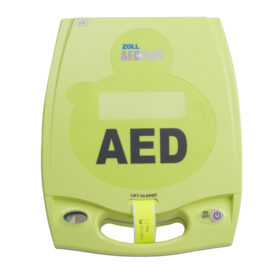
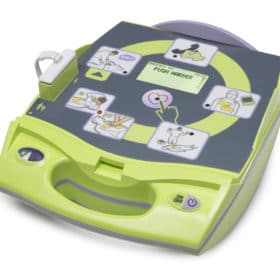
ZOLL AED Plus
The ZOLL AED Plus goes beyond basic defibrillation by including Real CPR Help technology that provides real-time feedback on compression depth and rate. This feature can dramatically improve CPR quality, which is crucial for patient outcomes. The device has a particularly long shelf life, with a five-year warranty on pads and batteries.
Pros: CPR feedback technology, long pad and battery life, excellent for trained responders
Cons: Higher price point, more features than untrained users may need
Best for: Businesses with trained safety teams or those wanting to maximize effectiveness of CPR
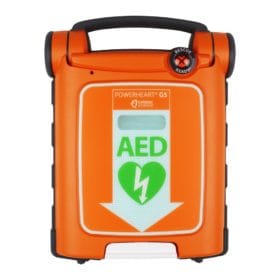
Cardiac Science Powerheart G5 AED
The Powerheart G5 is a premium, rugged AED designed for demanding environments. It features a color display with clear graphics, RescueCoach voice prompts that adjust pacing based on whether one or two rescuers are present, and exceptional durability. The eight-year warranty is among the longest in the industry.
Pros: Excellent durability, long warranty, advanced voice prompts, color display
Cons: Higher price point, larger and heavier than some models
Best for: Warehouses, manufacturing facilities, or environments where durability is paramount
Physio-Control LIFEPAK CR2 AED
The LIFEPAK CR2 represents the premium tier of business AEDs. It features WiFi connectivity for remote monitoring, a child mode that automatically adjusts energy levels, and cprINSIGHT technology that allows the device to analyze heart rhythm during CPR without pausing compressions. The large, clear display provides visual guidance throughout the rescue.
Pros: Advanced technology, WiFi connectivity, no interruption to CPR for rhythm analysis
Cons: Premium price, may be more complex than needed for basic office use
Best for: Larger businesses with multiple AEDs seeking integrated monitoring solutions
Defibtech Lifeline AED
The Defibtech Lifeline offers a budget-friendly entry point without compromising essential features. It includes clear voice and visual prompts, a straightforward two-button design, and a seven-year battery life that reduces ongoing costs. While it lacks some advanced features of premium models, it performs its core function excellently.
Pros: Most affordable option, long battery life, simple operation, good for basic needs
Cons: Fewer advanced features, less robust than premium options
Best for: Small businesses or organizations with tight budgets seeking a reliable basic AED
Defibtech Lifeline Business Package
This package includes the Defibtech Lifeline AED along with a wall cabinet, spare pads, signage, and other accessories needed for a complete installation. It offers better value than buying components separately and ensures you have everything needed from day one.
Pros: Complete package ready for installation, good value, includes all necessary accessories
Cons: Package components may not suit all environments (cabinet style, signage design)
Best for: Businesses seeking an all-in-one solution without researching individual components
AED Placement and Compliance for Offices
Strategic placement can significantly impact your AED’s effectiveness. The American Heart Association recommends placing AEDs so that any location in your facility is within 90 seconds of an AED (about a three-minute round trip).
For most offices, ideal placement locations include:
Reception or lobby area: High visibility, accessible to visitors, typically near phone for calling 911
Break room or kitchen: Central location where people gather
Main corridors: Between wings or floors in larger offices
Near high-risk areas: Gyms, stairs, or areas where physical exertion occurs
Mount your AED in a clearly marked cabinet (preferably with a glass front for visibility) at a height of 40-60 inches from the floor. Install clearly visible signage using the international AED symbol. Many businesses add illuminated signs or directional signs leading to the AED location.