
Have a question?
We are here to help.
Check out the most common questions our customers asked. Still have questions?

01
What is an AED
An AED — automated external defibrillator — is a portable device that reads a person's heart rhythm and, if that rhythm is one it can correct, delivers a controlled electric shock to reset the heart.
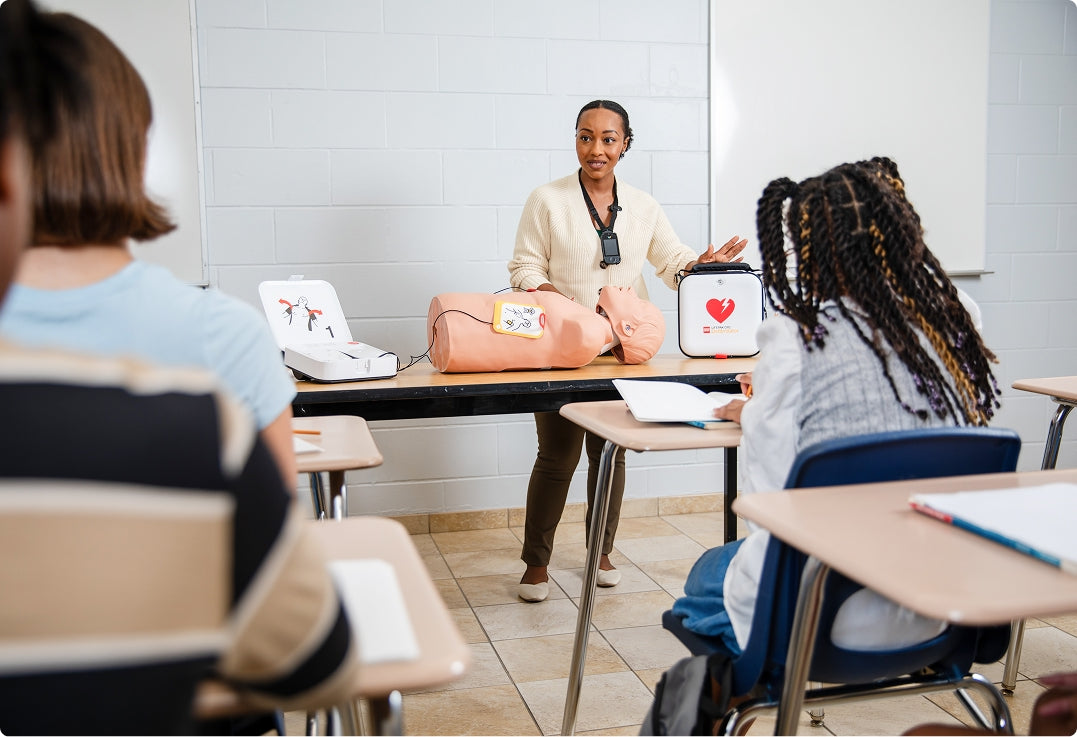
The word "automated" is the important part. The AED makes the medical decision, not you. It analyzes, it decides, and it tells you out loud what to do next, step by step. It's built to be used by anyone: a receptionist, a teacher or a gym member with zero medical training. Roughly the size of a laptop, it lives on a wall in a cabinet and does a self-test every day to confirm it's ready.
You cannot shock someone who doesn't need it. An AED will refuse to deliver a shock if the rhythm isn't shockable. That's the single most common fear — and it's the one thing the device is designed to prevent.





02
What an AED is actually treating
An AED treats Sudden Cardiac Arrest (SCA), which is different from a heart attack. A heart attack is a plumbing problem — an artery gets blocked and the person usually stays conscious. Sudden cardiac arrest is an electrical problem: the heart's rhythm collapses into chaos, it stops pumping, and the person drops within seconds.
CPR alone won't fix it. CPR buys time by keeping blood moving, but the only thing that resets the rhythm is a defibrillation shock. That's the entire reason an AED exists. SCA strikes without warning, and it doesn't respect age or fitness. It can happen to - high school athletes, healthy 35-year-olds, anyone at all.
Every minute counts, literally.If a patient is shocked within the first minute, survival is around 90%. Each minute that passes without defibrillation cuts the odds by roughly 10%. EMS response averages 8–12 minutes.

That's roughly 1,000 people a day. Nearly 90% are fatal — largely because a defibrillator doesn't reach the person in time.
Over 20 years of helping people feel ready, not rattled, when it matters most, with AEDs and support they can trust. Every device we place is one more chance for someone to make it home.
03
The chain of survival starts here, just stay calm and follow along. The AED will walk you through it.
1
Unresponsive and not breathing normally? Call 911 and send someone to grab the nearest AED.
2
On most models, opening the lid turns it on. The voice prompts start immediately.
3
Bare the chest completely. The pads have pictures on them showing exactly where they go.
4
Listen closely & follow the instructions the AED provides until paramedics take over.

04
Do I need an AED?
The honest test isn't whether your building is required to have one. It's this: if someone collapsed here right now, could an AED reach them in under three minutes? If the answer is no, you need a device — regardless of what your state mandates.
Two factors raise the stakes even higher: how many people pass through your space, and how far away the nearest ambulance is. A rural warehouse with 40 employees can be a higher-risk site than a downtown office with 400.
Many states already mandate AEDs in schools, health clubs, public buildings and childcare facilities, each with conditions like medical direction and EMS registration.

05
How many AEDs does your space need?
One is often not enough. The rule of thumb: from anywhere on site, a person should be able to fetch a device and get back to the victim within about three minutes — which usually means at least one per floor, plus extras for large footprints, gyms and remote wings.
Get a rough number in ten seconds below, then run the full calculator, which factors in occupancy type, headcount, floors and exercise areas — and recommends the right models.
Every FDA-approved AED can save a life. These are the features that decide which one fits
your environment.

Semi-auto asks the rescuer to press a shock button. Fully auto delivers it itself after a countdown. Fully auto removes hesitation — a real factor with untrained responders.

Some models measure compression depth and rate in real time and coach the rescuer. Worth it anywhere your responders are laypeople.

A key or button that switches to child energy levels — cheaper long-term than buying separate pediatric pads that will expire. Critical for schools and daycares.

Dust and water resistance (IP rating). Matters for outdoor cabinets, vehicles, pools, factories and construction sites.

Wi-Fi or cellular models report their own readiness status to a web portal. A game-changer if you manage devices across many sites.

Pad and battery pricing varies a lot by brand. A cheaper device with expensive consumables can cost more over eight years.

07
The device is the big line item, but it isn't the only one. Here's the honest picture over a typical four-year window.
| Typical range | Frequency | |
|---|---|---|
| AED device | $1,400 – $2,500+ | One-time (8–10 yr lifespan) |
| Adult electrode pads | $50 – $200 | Every 2–4 years, or after any use |
| Pediatric pads / key | $75 – $230 | Every 2–4 years |
| Battery | Varies by model | Every ~4 years |
| Wall cabinet, sign, stickers | $5 – $250+ | One-time |
| AED trainer (optional) | $400 – $600 | One-time |
| Ongoing upkeep | ~$75 / device / year | One-time |
Prices are indicative and vary by model and configuration. Tax-exempt organizations and volume buyers should request a quote rather than buying at list.

Subscription program
Stay Compliant.
Stay Ready.
Save Lives.
Take the guesswork out of AED ownership with an all-in-one monthly package that includes your AED, compliance support, device monitoring, supply tracking, medical direction, and more. Keep your organization rescue-ready without unexpected costs or complicated paperwork.
Explore Readiness Packages
Unbeatable Prices, Unmatched Service
Interested in purchasing AEDs or in need of a purchase order? Look no further – we’re here to assist!

Check out the most common questions our customers asked. Still have questions?
Contact our customer support.