AED Brands Blog

ROI of an AED


Nicole

Commonly, ‘Return on Investment – ROI’ is used to calculate the value of a newly proposed project for any business, church or school. ROI takes account the earning power of and investment compared to the cost. I am here to point out that some investments are not measured in dollars, but in the ability to save a life.

First I would consider the capital gains of saving a beloved family member or friend. For instance, your elementary school aged child has a basketball game in the local public school, and in an instant the coach falls to the ground in cardiac arrest. What now?

• Call 911 Emergency Services.

• Discover the AED your child’s elementary school provides.

• Begin CPR , defibrillate patient and await medical professionals.

At this point in time, the investment of an AED is priceless. The overall gain from a $1400 device is a father, coach and friend that survived because of an effective AED implementation program. Approximately 3,000 Americans a day fall victim to Sudden Cardiac Arrest. The investment of an AED may seem tight for any budget; however, the life that is saved may be your own.

I will leave you with a few fundraising ideas to consider beginning your AED implementation program:

1. Ask 70 members of your church or school for a $20 donation. Explain how the funds will be used for an AED. Track the progress of your fundraiser in a public area. Lastly, offer to demonstrate the AED to all people that have generously donated.

2. Have members of your school or congregation donate items they no longer need to a Community Garage Sale. Use the proceeds to buy an AED, and hold a training to encourage everyone to understand the benefits.


VN:F [1.9.11_1134]
Rating: 10.0/10 (1 vote cast)
VN:F [1.9.11_1134]
Rating: 0 (from 0 votes)

Automated External Defibrillator Manuals, Brochures, and Data Sheets


Nicole

This week, once again, we want to point you to our free AED Resource Center and direct your attention to our AED documents section. In this area, we provide access to a large selection of AED manuals, data sheets and brochures for the automated external defibrillators that are on the market today. We have provided this resource to help you decide on the best AED model for your needs by offering AED brochures and data sheets, or to replace an AED manual that may have been lost or become worn out.

On the AED Document Center page, you will find links to Philips AED manuals for the HeartStart Onsite, the FRx, and the FR2 AED models. We also have Cardiac Science brochures for the Powerheart G3 Pro and G3 Plus AEDs. You will also find Medtronic Physio-Control AED data sheets for the LIFEPAK CR Plus, 1000 and 500 AED models as well as Zoll AED Plus and Zoll AED Pro AED manuals, brochures and data sheets. Available for download also, are Defibtech Lifeline and Defibtech View brochures and data sheets and HeartSine samaritan PAD brochures and data sheets. The Welch Allyn AED 10 and AED 20 AED manuals, data sheets and brochures can also be downloaded free.

AED Brands wants you to have as much information about your AED model as possible. Making the data easily accessible was just as important as what we made available. All you have to do is visit the AED Document Center page, click on the AED model of your choice, and view the AED manuals, data sheets, brochures, and more for your automated external defibrillator model.

VN:F [1.9.11_1134]
Rating: 0.0/10 (0 votes cast)
VN:F [1.9.11_1134]
Rating: 0 (from 0 votes)

IP Ratings for Automated External Defibrillators


Nicole

As most of us know, electrical items, such as automated external defibrillators, as well as radios, televisions and computers, can be sensitive to moisture and dust. We’ve all seen the warning labels on hair dryers that show how dangerous it can be if such an item is used near water. Generally speaking then, it’s a good idea to keep all electrical equipment away from water and other moisture, as well as dust. The risk of electrocution is the main reason, but also, dust and water can short out an electrical component making it unusable. However, sometimes keeping electrical items away from moisture is not possible, especially if it’s an AED located in a gym or pool area, or out on a golf course. It becomes necessary then, to have special enclosures made for AEDs and other electrical components to protect them from dust and water.

The European Committee for Electro Technical Standardization developed what is known as Ingress Protection (IP) ratings for such enclosures. The IP code specifies the environmental protection that each enclosure provides. The ratings normally have two numbers but sometimes three. For automated external defibrillators, two numbers are used.

The first number is used to indicate the level of protection a piece of equipment has against solid objects or dust. The second number indicates the level of protection the unit has against water. For example, if an AED has an IP rating of 11 that would mean the unit is protected against solid objects that are up to 50 mm, or a force equivalent to the accidental touch of a person’s hands. The second number 1 indicates that the AED is safe from vertically falling drops of water, such as condensation. If an automated external defibrillator has an IP rating of 00 or if one of the numbers has been replaced with an X, then there is no protection. Therefore, an IP rating of X1 would indicate that the unit is only protected against vertically falling drops of water, or condensation, not against dust or other solids.

AED Brands has put together a chart that shows the various levels of protection for AEDs with IP ratings. To view the chart, please visit the AED Brands free Resource Center. You can also compare the IP ratings for the AEDs we carry by accessing the product comparison feature we have on our home page.

VN:F [1.9.11_1134]
Rating: 0.0/10 (0 votes cast)
VN:F [1.9.11_1134]
Rating: 0 (from 0 votes)

Long QT Syndrome and Sudden Cardiac Arrest


Nicole

Educating the American public about the dangers of sudden cardiac arrest (SCA) and the importance of automated external defibrillators (AEDs) is the mission of AED Brands. SCA is one of those health conditions that can be hard to treat and even harder to predict. However, today we want to direct your attention to one of the predictors that can serve as an early warning system, if you will, of a person’s likelihood of suffering a sudden cardiac arrest.

Long QT Syndrome, or LQTS, is a heart disorder and it can seriously affect the rhythm of a person’s heartbeats. LQTS can either be inherited or acquired (by taking certain medications). People who have inherited Long QT Syndrome do so through one or both of their parents. Therefore, if a family member has tested positively for LQTS, it is imperative that all family members be tested, including the siblings, children and parents of the person who tested positively.

People taking medications such as Thorazine, Biaxin, Prozac, Haldol (and many others) need to be aware that they could acquire Long QT Syndrome by using these drugs and they need to be aware of the side effects that indicate LQTS before a sudden cardiac arrest happens. Long QT Syndrome is usually discovered when a person experiences unexplained seizures or fainting spells, especially during an exercise session or other physical activities, or even upon becoming intensely angry, frightened, or startled.

The good news is that Long QT Syndrome can be treated by medications, surgery or implantable defibrillators and that it can be diagnosed in people with the inherited form. We have an article on Long QT Syndrome in our free AED Resource Center where you can find more information on LQTS and why it causes the heart to beat erratically. We hope you will educate yourself, and your friends and family, about this life-threatening heart condition and help us spread the word about Long QT Syndrome and its potential relationship to sudden cardiac arrest.

VN:F [1.9.11_1134]
Rating: 10.0/10 (1 vote cast)
VN:F [1.9.11_1134]
Rating: 0 (from 0 votes)

ADA Guidelines for AED Placement


Nicole

The Americans with Disabilities Act (ADA) was enacted to ensure that Americans who are differently-abled than the general public have the same rights as everyone else to be employed. The ADA publishes guidelines for buildings and facilities so that building and business owners know what the law requires in terms of the placement of health and safety equipment. AED Brands recommends using the ADA’s guidelines to determine proper automated external defibrillator (AED) placement in all public gathering places.

Today we posted an information page in our free AED Resource Center outlining the ADA’s specifications for automated external defibrillator mounting heights and the proper wall projections for AEDs that are stored in wall cabinets. We recommend reading these ADA guidelines to make sure that your AED program is compliant.

The groundbreaking legislation called the Americans with Disabilities Act was enacted for employers with 25 or more employees in July 1992. Two years later, in July 1994, employers with 15 or more employees were covered. The ADA established that discrimination against individuals with disabilities was illegal in the workplace. This meant that employers could not refuse to hire an individual with a disability for a position if that individual met the essential requirements of the position with or without reasonable accommodation.

AED Brands believes in the Americans with Disabilities Act and continues to work with employers all across the country to ensure that the numbers of people who die from sudden cardiac arrest each year keep declining.

VN:F [1.9.11_1134]
Rating: 0.0/10 (0 votes cast)
VN:F [1.9.11_1134]
Rating: 0 (from 0 votes)

Federal Cardiac Arrest Survival Act


Nicole

In January 2000, the 106th Congress of the United States amended the Public Health Service Act to include the Federal Cardiac Arrest Survival Act (CASA). On January 24, 2000, the President signed the Act. The CASA recommends the placement of automated external defibrillators, or AEDs, in all Federal buildings and provides for Federal Good Samaritan protection to emergency first responders who use AEDs.

AED Brands has provided a copy of CASA in our free AED Resource Center. We encourage you to download and read the Federal Cardiac Arrest Survival Act (PDF format) and to think about your own place of business. It doesn’t matter if you don’t work in a Federal building. All public gathering places, such as churches and synagogues, convention centers, fitness centers and gyms, golf courses and schools, should have AED programs in place and AED units on site.

The American Heart Association estimates that over 350,000, maybe up to 400,000, Americans suffer from sudden cardiac arrest (SCA) each year. If left untreated, many of these SCA victims die. If an AED is available and used, up to 30 percent of these SCA suffers may survive. SCA victims can be young or old, healthy or unhealthy. It doesn’t matter. Every American is a potential SCA victim. That is why AED Brands has made it our mission to educate and inform the public about automated external defibrillators and their importance in the treatment of sudden cardiac arrest.

AEDs are the only way to get an SCA victim’s heart out of ventricular fibrillation (VF). VF occurs when the heart starts to beat erratically and out of rhythm. Within seconds, the victim loses consciousness, collapses and stops breathing. Cardiopulmonary resuscitation (CPR) should be started immediately but it alone will not, and cannot, defibrillate the heart. An AED is the only life-saving option.

Time is of the essence during an SCA. For each minute that passes during sudden cardiac arrest, the chances of a victim suffering brain damage or death, increases by ten percent. This means, that in less than ten minutes, the victim could die. Using an AED dramatically increases the chances of survival.

AED Brands wants to educate and inform the American public about automated external defibrillators and their importance in the treatment of SCA. Without early defibrillation, a victim’s survival is in jeopardy. Without AEDs available in all public gathering places, SCA victims hardly stand a chance. Please read the Federal Cardiac Arrest Survival Act and consider starting an AED program at your place of business, worship or recreation center. Your life could depend upon it!

VN:F [1.9.11_1134]
Rating: 0.0/10 (0 votes cast)
VN:F [1.9.11_1134]
Rating: +1 (from 1 vote)

AED Electric Shocks: What Exactly Are Joules?


Nicole

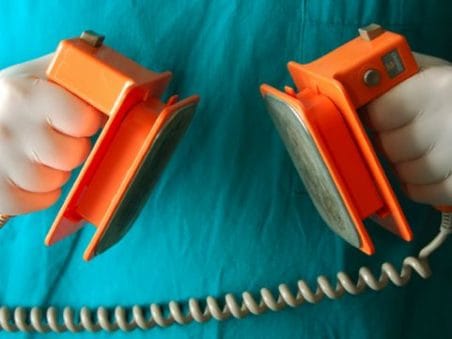
I’m sure we’ve all seen the medical drama on TV or a movie with a scene in a hospital where a patient is in sudden cardiac arrest and the doctor calls for the crash cart. The nurse flips the switches, hands the paddles to the doctor; he or she steps up to the patient, and says, “Clear!” Everyone moves back, the doctor applies the paddles to the patient’s chest, and the patient is jolted with a current of energy. Have you ever wondered what exactly that shock is and how it works? We did too, so we did some research and put up a new page in the free AED Resource Center entitled, “What Are Joules?

The defibrillators used in real hospitals are slightly different from the automated external defibrillators, or AEDs, that AED Brands sells but they work in the same way and serve the same purpose. AEDs for public use are smaller, easier to transport and use, and made for use by non-medical personnel. However, the energy used, also known as joules (j), is the same energy used in professional AEDs.

Joules, named after James Prescott Joules, the British physicist who discovered them, are the unit of electrical energy that an AED generates and delivers to its electrodes and pads, through the skin of the victim and into the victim’s fibrillating heart. This defibrillation causes the heart to briefly cease beating and then restart, hopefully getting the heart beating back into its normal rhythm. AEDs are the only way to get a heart out of this condition known as ventricular fibrillation.

Sudden cardiac arrest, or SCA, strikes nearly 400,000 Americans each year. The majority of these victims die before help arrives. Automated external defibrillators in public gathering places are one of the best ways to ensure that SCA victims live long enough to get to the hospital and receive the treatment they need to survive.

AED Brands’ mission is to assist the public in obtaining automated external defibrillators for schools, health clubs, airports, golf courses, places of worship and other public gathering places. We also want to educate the public and support them in implementing AED programs that are compliant and effective. AED Brands’ free AED Resource Center provides articles on everything you need to educate yourself and others on the importance of AEDs, how they work, why they are needed and even answer some technical questions, like, “What Are Joules?” We invite you to visit these resources and learn as much as you can about this all-too-often deadly health emergency known as sudden cardiac arrest and how to treat it.

VN:F [1.9.11_1134]
Rating: 0.0/10 (0 votes cast)
VN:F [1.9.11_1134]
Rating: 0 (from 0 votes)

Fundamentals for a Successful AED Program


Nicole

Automated external defibrillators (AEDs) are one of the most important items for a business or other public gathering place to have in its emergency first aid arsenal.

However, just having an AED on hand does not ensure that if (and more likely, when) a sudden cardiac arrest (SCA) happens that the victim will receive the life-saving care they need. Because time is of the essence during an SCA (3 – 5 minutes is the optimal response time recommended by the American Heart Association) a well-planned and well-thought out AED program is necessary. Well-trained emergency first responders are a vital component as well.

That is why we have updated our article on “Automated External Defibrillator Program Essentials” in our free AED Resource Center today.

In this important section, we highlight AED Policies and Procedures, AED Site Assessments, AED Program Education, and CPR/AED Certification, to mention just a few items of significance.

Educating yourself and your employees about sudden cardiac arrest and how to set up an AED program and what is required to make it successful can mean the difference between life and death. SCA happens nearly 1,000 times per day across the United States. It does not distinguish between young and old, rich or poor, healthy or unhealthy. It cannot usually be predicted or prevented, but it can be treated. AED Brands’ mission is to make the American public aware of this life-threatening condition and to ensure that SCA victims receive the treatment they need before it’s too late.

Do yourself, your employees, your visitors and guests a favor, and read the article. Then, make sure you have an AED program in place. The life you save, may be your own!


VN:F [1.9.11_1134]
Rating: 0.0/10 (0 votes cast)
VN:F [1.9.11_1134]
Rating: 0 (from 0 votes)

AEDs Save Lives


Nicole

Sudden cardiac arrest, or SCA, is a leading cause of heart related fatalities each year in the United States. It is estimated that each day nearly 1,000 people suffer this unpreventable health crisis. However, even though SCA cannot be prevented, it is treatable and if the right equipment, an automated external defibrillator, is available and used within minutes of the attack, many lives can be saved.

Automated external defibrillators, or AEDs, are the only method of preventing an SCA from ending in death. Cardiopulmonary resuscitation (CPR) is important, but only AEDs can stop the ventricular fibrillation (the erratic, abnormal rhythm of the heart during an SCA). Ventricular fibrillation is stopped when the AED delivers an electric shock to the victim’s heart and defibrillates it back into a normal rhythm. To learn more about how an AED works, one of the articles in AED Brands’ free AED Resource Center provides a fascinating systematic glimpse of the procedures that took place during an actual sudden cardiac arrest save.

The graphic below shows what was happening to the SCA victim’s heart at 9:54:38 am, two minutes and 53 seconds after the person collapsed. The automated external defibrillator had indicated that the victim was in sudden cardiac arrest and that a shock was needed. All the rescuer had to do was press the “Shock” button. The AED did the rest. CPR was performed during the rescue, but the AED was needed to restart the heart and to get it beating normally again. AEDs are the only way to get a heart out of ventricular fibrillation.

It is AED Brands’ sincere hope that after reading about the AED SCA save, you will realize how important AEDs are to the American public. AED legislation has been enacted in all 50 states but more needs to be done to get this life-saving equipment in every public gathering place and in every police and emergency rescue vehicle. Only with the public’s awareness can more lives be saved from sudden cardiac arrest by the use of automated external defibrillators.


VN:F [1.9.11_1134]
Rating: 10.0/10 (1 vote cast)
VN:F [1.9.11_1134]
Rating: +1 (from 1 vote)

Automated External Defibrillator Pads


Nicole

Expiration dates, it seems that everything has them nowadays: batteries, milk, medicines, you name it; most things spoil or lose their efficacy over time. However, did you know that automated external defibrillator (AED) pads expire as well? Maintaining and keeping your AED unit and its accessories serviced is an important part of your AED program. Keeping the battery charged and having a back up on hand is important, but so too are the pads.

It may not be news to you that AED pads expire, but do you know why? In our free AED Resource Center, we have posted an information page answering the question, “Why do AED pads expire?” We encourage you to visit this page for the answers to why you need to check your AED pads’ expiration dates, and to have extras on-hand. The typical life span of automated external defibrillator pads is between 18 and 30 months. Implementing and adhering to a routine maintenance schedule for all your first aid medical supplies is a good idea. Ensuring that your AED’s battery and AED pads are still fresh could mean the difference between life and death. Don’t get caught with expired AED pads; check yours today and make sure you are in compliance.

VN:F [1.9.11_1134]
Rating: 0.0/10 (0 votes cast)
VN:F [1.9.11_1134]
Rating: 0 (from 0 votes)
  • We Accept Purchase Orders
  • FedEx Free Shipping
  • 30-day Money Back
  • 110% Guaranteed
  • Authorized Dealer
  • BBB Accredited Business
  • FDA Approved